
AI + Content
How AI Is Changing the Way Customers Find Local Businesses.
AI is becoming part of how people search, compare, plan, and decide who to trust. For local businesses, the answer is real media, clear context, and a content system that makes the business easier to understand.
By Maverick Beach / June 22, 2026
This guide combines source-backed context with Maverick Beach Creative’s working approach to planning and producing small-business content.
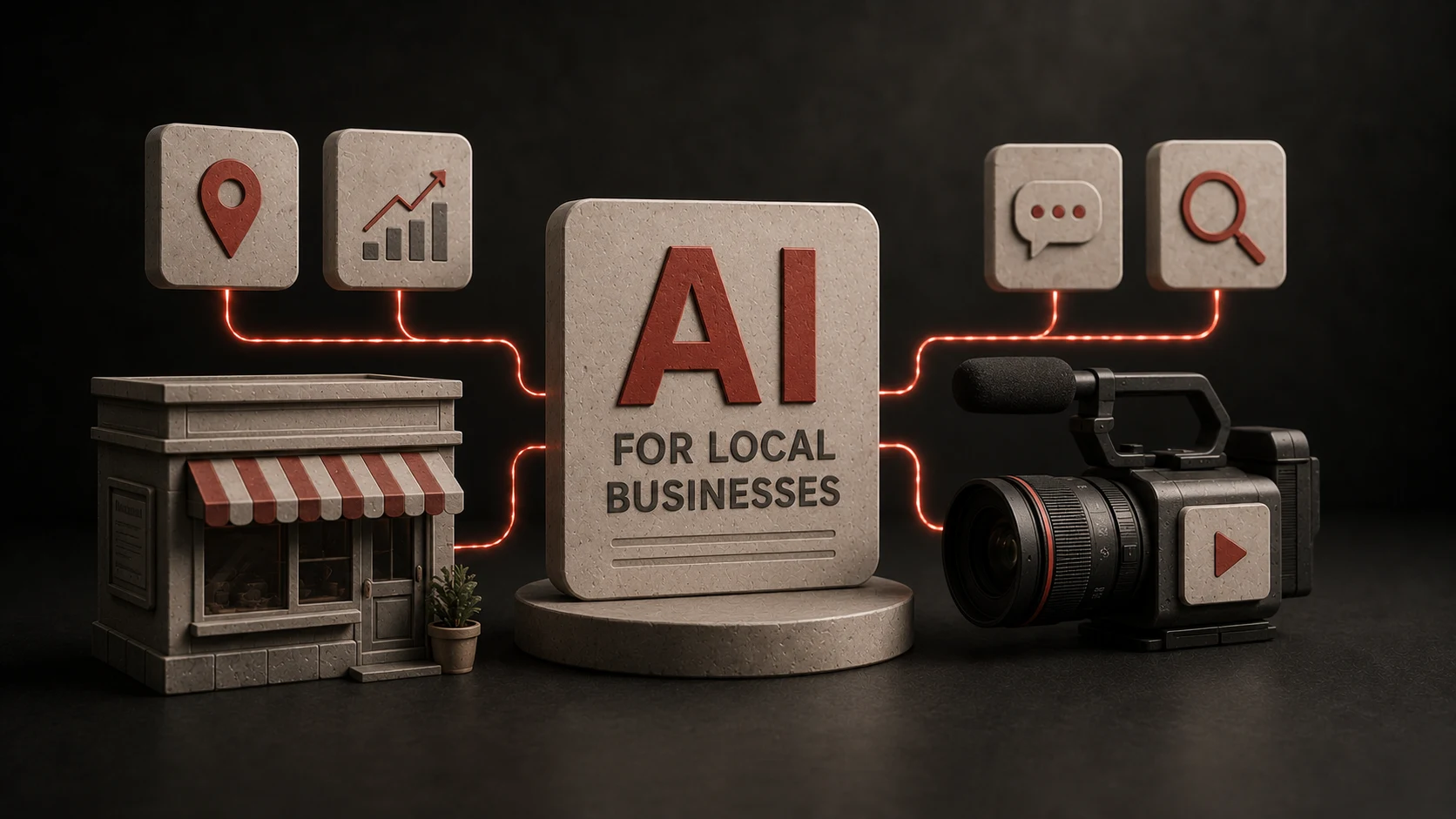
AI is not just a tech trend. It is becoming part of how people search, compare, plan, ask questions, and decide who to trust.
For a local business, that matters.
Not because the business needs to start posting fake AI images or robotic captions. Because the business needs to become easier to understand.
Why real content helps customers and AI systems understand a local business.
AI needs context. Search engines need context. Customers need context.
Content marketing is how a business creates that context.
Real video, strong photos, useful captions, clear website pages, helpful articles, accurate business profiles, and direct answers to customer questions all help explain what the business does, who it serves, and why someone should care.
That is the real connection between AI and media. It is not about replacing the business with AI. It is about using real content to make the business more visible, more understandable, and easier to choose.
Local businesses need clear information online.
Most local businesses are not short on proof. They have real work happening every day.
A restaurant has food, service, atmosphere, regulars, prep, details, specials, staff, and a room people want to feel before they visit. An auto shop has process, tools, repairs, diagnostics, customer questions, before-and-after proof, and expertise that most people never see. An outdoor brand has product details, field use, weather, terrain, materials, lifestyle, and a reason the product exists.
A guide service has location, preparation, safety, experience, knowledge, and trust. A contractor has craft, equipment, jobsite proof, problem-solving, finished work, and a process that helps people feel safer hiring them.
The problem is not that the business has nothing to say. The problem is that most of it never gets captured, organized, explained, or published in a way people can actually use.
That used to be a missed marketing opportunity. Now it is also a missed context opportunity.
What does AI have to do with local marketing?
A customer used to search something like “best restaurant near me,” “diesel shop near me,” “Bend Oregon video production,” or “drone video for real estate in Central Oregon.”
That still happens.
But more people are also asking AI tools bigger questions.
“What kind of video should a small business make before launching a new service?”
“Find a local company that can shoot video, edit reels, handle drone, and clean up audio.”
“What should I look for before hiring a Bend video creator?”
“Which business seems more trustworthy?”
“What are the signs this company actually knows what it is doing?”
That changes the game. The business is no longer only competing for one search result, one map listing, or one social post. It is competing to be understood.
AI systems, search engines, and customers are all looking for signals. Clear pages. Specific language. Real media. Consistent business information. Helpful answers. Proof that the business does what it says it does.
That is why content marketing matters more, not less.
Automation, AI agents, and agentic AI in normal business terms.
Automation is the simple version. If this happens, do that.
Someone fills out a form, they get an email. A post gets scheduled. A file moves into a folder. A lead goes into a CRM.
An AI agent is more flexible. It can work toward a goal, use tools, read information, compare options, and take steps on behalf of a user.
Agentic AI is the bigger direction. Instead of a person typing one search and clicking through every result manually, they may ask an AI system to research, compare, summarize, recommend, organize, or start the next step.
That does not mean AI magically knows everything. It means the information available about the business matters.
If the business has weak context online, it gives people and AI systems less to work with. If the business has strong context online, it becomes easier to explain, easier to compare, and easier to recommend.
Content gives customers context about the business.
A single post can get attention. A content system builds understanding.
That system might include short videos that show the work, photos that show product and place, captions that explain what people are seeing, website service pages that answer what the business offers, resource articles that answer customer questions, FAQs that remove confusion, and Google Business Profile updates that keep local information current.
It can also include video descriptions, transcripts, internal links, structured data, and clear calls to action that connect attention to the next useful step.
That is not just “posting.”
That is building a context layer around the business.
The more clearly that layer explains the business, the easier it becomes for customers, search engines, and AI tools to understand what the business is actually good at.
Video can earn attention, while clear information helps customers evaluate the business.
Video matters because it shows reality quickly. People can see the room, hear the environment, watch the process, feel the pace, and notice the details.
That is why real media has value in an AI-heavy world.
AI can generate a polished sentence. It cannot honestly document the real Saturday night rush at a restaurant. It cannot replace footage of the actual shop, actual product, actual process, actual crew, or actual place.
It cannot create trust the same way real proof can.
But video alone is not enough. The business still needs explanation.
A strong caption tells people what matters. A strong website page gives the topic a permanent home. A strong article answers the question behind the search. A strong content library helps the business show up with more clarity in more places.
The media gets attention.
The context makes it useful.
What answer engine optimization (AEO) involves.
AEO, or answer engine optimization, is usually just a newer way of talking about being easier for search and AI systems to understand.
That does not mean stuffing pages with keywords. It does not mean writing robotic answers. It does not mean publishing hundreds of thin articles so the business looks bigger than it is.
It means the business should have clear, useful, specific information available in places that can be crawled, indexed, read, and trusted.
For a local business, that can include service pages, FAQs, articles, video captions, transcripts, Google Business Profile updates, accurate business details, internal links, and structured data where it accurately represents visible page content.
The point is not to trick the system.
The point is to remove confusion.
The wrong way to use AI.
There is a bad version of AI marketing.
It looks like fake volume. Generic captions. Robotic blog posts. Thin service pages. AI images pretending to be real work. Trend-chasing that has nothing to do with the business. Endless content that says almost nothing.
That kind of content might look active from a distance, but it does not build much trust. In some cases, it makes the business feel less real.
That is the risk right now. A lot of businesses are using AI to sound bigger, smoother, and more polished, but they are losing the thing customers actually wanted from them in the first place.
Specificity. Proof. Personality. Local context. Real people. Real work.
Use AI behind the scenes while keeping public content grounded in the real business.
The smarter move is simple.
Keep the front end human. Use AI behind the scenes.
AI can help organize ideas, sort customer questions, outline content, turn transcripts into drafts, find gaps on a website, build shoot lists, repurpose long videos, generate caption options, and make the content process less overwhelming.
But the public-facing material should still come from the real business.
Real footage. Real photos. Real people. Real locations. Real products. Real process. Real voice. Real judgment.
That is where a local business can win. Not by looking like every other AI-generated brand, but by being easier to understand while still feeling unmistakably real.
Real footage and specific business information remain important.
The more generic AI content fills the internet, the more valuable real proof becomes.
That does not mean content has to look rough. A polished video can be authentic. A clean website can be authentic. A planned shoot can be authentic. A strong edit can be authentic.
Authenticity does not mean low quality. It means the content is connected to something real.
For local businesses, that is an advantage. People want to know what the place feels like. They want to see the work. They want to understand the process. They want to know who they are hiring, visiting, buying from, or trusting.
AI makes generic content easier.
That makes real content more valuable.
This is where content marketing fits.
Content marketing is not just posting more. It is building the creative backbone of the business.
It helps people recognize the business before they need it. It helps them understand the offer. It answers the questions they were already asking. It gives sales conversations more support. It makes the website stronger. It gives search and AI systems clearer information. It turns real work into reusable proof.
A good content system does not need to be massive. It needs to be clear.
For a local business, the right starting point might be one strong brand video, a set of short clips from the same shoot, a service page refresh, a batch of useful captions, a few FAQ-driven articles, a before-and-after edit, a Google Business Profile content refresh, or a simple content audit to figure out what is missing.
The goal is not to flood the internet.
The goal is to make the business easier to find, easier to understand, and easier to trust.
Why this matters now.
The businesses that wait may not disappear. But they may become harder to explain.
A competitor with clearer video, better captions, stronger service pages, useful articles, updated local listings, and a more complete content library gives people more reasons to pay attention.
It also gives search and AI systems more accurate context to work with.
That does not guarantee a specific ranking, lead, sale, or AI recommendation. Nothing does.
But it improves the foundation.
A business that is clearly documented is easier to discover. A business that is clearly explained is easier to compare. A business that feels real is easier to trust.
Where Maverick Beach Creative fits.
Maverick Beach Creative helps local and regional businesses turn real work into useful finished content.
Video production, editing, drone, audio, sound design, shortform content, website-supporting media, and content direction all work together toward the same goal:
Make the business look as good online as it does in real life.
That does not mean turning the business into something fake. It means capturing what is already there and shaping it into content people can actually use.
The food, the shop, the crew, the process, the product, the sound, the atmosphere, the movement, the detail, the care, the reason someone should trust it.
AI can support the backend.
Maverick Beach Creative is built around the part AI cannot honestly replace: real footage, real editing, real sound, real pacing, real taste, and real business context.
Questions to answer before investing in more content.
A local business does not need to become an AI company. It needs to stop being invisible in the places people are looking.
Start by asking:
Those answers usually reveal the next move.
- Can someone understand what the business does in 10 seconds?
- Does the website clearly explain the services?
- Do the captions say anything useful?
- Does the business have current photos and videos?
- Are common customer questions answered anywhere?
- Does the Google Business Profile feel alive?
- Is there content that proves the business is real?
- Can the same shoot create multiple useful assets?
- Is AI being used to support the workflow, or is it replacing the voice of the business?
Final Take.
AI is not the replacement for local business marketing.
It is the pressure test.
It exposes which businesses are clear and which ones are vague. It rewards useful context. It makes generic content easier to create, which makes real content more important.
The businesses that win will not be the ones posting the most AI-generated noise. They will be the ones that show the real work, explain it clearly, and build a content system that helps the right people understand why they should care.
Get on the train.
Just do not let it drive the brand.
Use AI behind the scenes. Keep the front end human. Make the business impossible to misunderstand.
Need help figuring out what your business should show first?
Maverick Beach Creative helps Bend, Central Oregon, Eastern Oregon, Columbia Gorge, and Pacific Northwest businesses turn real work into useful finished content.
Start with a quote request or Content Fit Check if the business needs a clean first step. Start with a Content Opportunity Audit if the business already has content, footage, or marketing activity but needs clearer direction.
How this applies to businesses in Bend and elsewhere.
For small businesses using AI, the useful move is usually small and practical: reduce repetitive work while keeping the real voice, footage, customer context, and final decisions connected to the business.
Based in Bend, Oregon, AI stays in a support role: useful for organization and workflow, not a replacement for voice, footage, judgment, or finished creative.
Sources8 references used for context
This guide combines source-backed context with Maverick Beach Creative’s working approach to planning and producing small-business content.
- Optimizing your website for generative AI features on Google Search — Google Search CentralSupports the guidance on making useful, crawlable business information available for Google Search and its AI features.
- Guidance on generative AI content on your website — Google Search CentralSupports using AI to help create useful content without producing low-value pages primarily to manipulate rankings.
- What is agentic AI? — IBMProvides background on AI systems that can pursue goals, make decisions, and coordinate steps with limited supervision.
- What are AI agents? — IBMProvides background on AI agents, tools, goals, and multi-step task completion.
- Get Listed on Google — Google Business ProfileSupports keeping local business information accurate and visible across Google Search and Maps.
- Local Business structured data — Google Search CentralSupports using accurate structured data to describe visible local-business information.
- The State of Social Media 2026 — Sprout SocialProvides current context on social media expectations, audience behavior, and brand content.
- Social Media Trends 2026 — Sprout SocialProvides current context on social content trends and the value of recognizable, human brand communication.
Related Next Steps