AI + Content
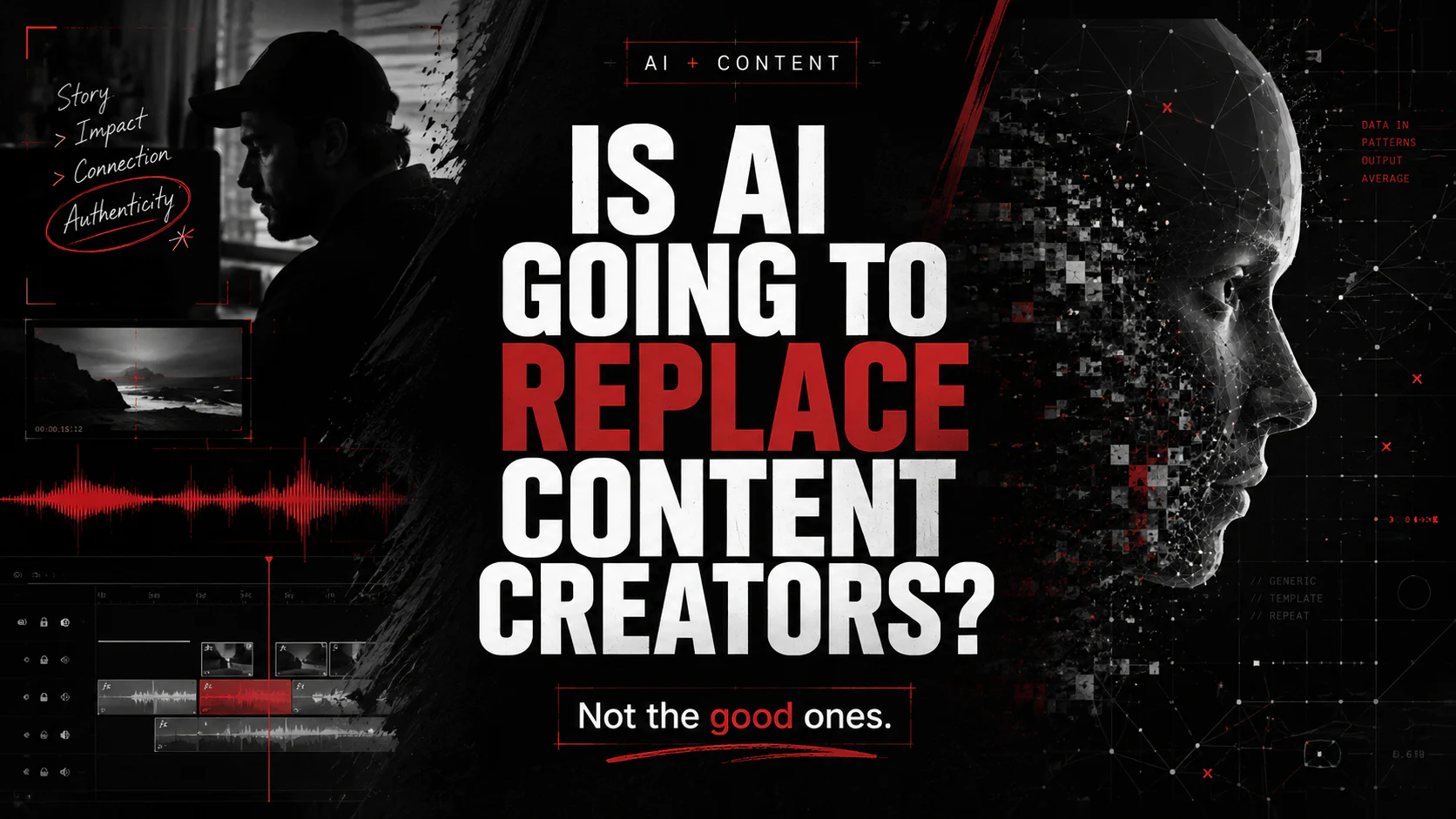
Is AI Going to Replace Content Creators?
AI is not going to replace good content creators. It is going to replace lazy ones, speed up the good ones, and make creative judgment more valuable than ever.
By Maverick Beach / June 10, 2026
No.
AI is not going to replace good content creators. It is going to replace lazy ones.
If the work you create can be fully replaced by what AI can do right now, there probably was not much there to replace in the first place. That may sound harsh, but it is also the part of this conversation people avoid.
AI is powerful. It is useful. It is probably one of the most valuable intangible tools business owners have ever had access to, especially for marketing. But it is still a tool.
The people who understand how to use it are going to move faster. The people who use it as a shortcut for taste, context, effort, and original thought are going to create the same generic AI slop everyone is already tired of seeing.
AI is good at pieces. Not finished creative.
Right now, AI is very good at helping with small pieces of the process.
It can help create parts of graphics. It can help clean up ideas. It can help write rough drafts, organize thoughts, create outlines, build scripts, generate captions, brainstorm hooks, summarize footage, and speed up boring tasks that used to eat hours.
Content creation is full of time-consuming little jobs. Renaming files. Organizing ideas. Building rough captions. Sorting through notes. Making versions. Planning post ideas. Cleaning up small details in graphics. Getting unstuck. AI can help with a lot of that.
But that is different from making a finished piece of creative that feels real, polished, emotionally correct, and connected to a brand.
AI can generate options. It can imitate structure. It can create pieces. It does not know what your business feels like when the shop is moving, when the kitchen is in the middle of service, when a product is being used in the field, when a truck is about to make a pass, or when a person is explaining something they actually understand. That context still has to come from the real world.
AI does not create from emotion.
AI can imitate emotion. It can be prompted to make something feel happy, dramatic, intense, clean, nostalgic, or sad. But it does not feel those things.
It creates from patterns and logic. It does not have the human context that makes emotion land correctly. It does not know what a moment meant on set, what the business owner cared about, what was hard to capture, or the difference between a shot that is technically fine and a shot that actually says something.
That is why taste still matters. A good creator is not just pressing record or dropping clips on a timeline. A good creator is making decisions: what matters, what should be left out, where the edit should breathe, where the sound should hit, and what the audience needs to understand first.
AI can help move the process along, but it cannot replace that kind of judgment.
Business owners are looking at AI the wrong way.
A lot of business owners seem to fall into one of two camps. They either think AI is going to save them money by replacing people, or they think AI is going to ruin everything and make their business feel fake. Both views miss the point.
AI is not automatically good or bad. It depends who is using it and how much context they give it.
The people getting bad AI results are usually giving bad AI inputs. They type one sentence, expect it to magically understand their business, and then wonder why the output sounds like every other generic post on the internet. That is not really an AI problem. That is a direction problem.
AI can help create copy, parts of content, scripts, storyboards, captions, outlines, and campaign concepts quickly. But it only becomes useful when someone understands the brand, the audience, the footage, and the goal.
AI should make your day-to-day content work easier.
For small businesses, the best use of AI is not some massive overhaul that sounds scary and abstract. The best use is simple: make the annoying content work easier.
What should we post this week? Can this long video become ten smaller clips? Can this footage become reels, website content, captions, and YouTube ideas? Can we write captions that do not sound fake? Can we organize our content ideas so they do not disappear?
That is where AI becomes useful. Not as a replacement for the brand, real footage, editing, taste, or creative direction. As support.
AI is like every major tool shift.
New tools feel strange at first. Some people misuse them. Some reject them. Eventually, the useful parts become normal.
AI is going to take over a lot of the repetitive work, blank-page work, sorting, drafting, outlining, organizing, and first-pass thinking.
That does not make humans less important. It means humans should spend less time on tasks that drain their energy and more time solving problems, making decisions, building better businesses, and doing the work that actually requires a human brain.
What content creators should do with AI.
If you are a content creator, do not use AI to become lazy. Use it to become more efficient.
Use it to organize thoughts faster, test angles, draft captions, build shot lists, speed up planning, and get through the boring parts so more energy can go toward the parts that actually make the work good.
The creators who refuse to learn it are going to get slower compared with the ones who do. The creators who rely on it completely are going to sound generic. The advantage is in the middle: using AI as a tool while keeping human taste, context, and standards in control.
What small businesses should do with AI.
Small businesses should not be scared of AI, but they also should not expect it to magically understand their brand.
The better approach is to build a content workflow where AI helps with the day-to-day mess: organizing footage, turning one shoot into multiple ideas, outlining captions, drafting hooks, planning posts, repurposing long videos, and organizing product or service talking points.
That is where AI can save time without making the business feel fake. But the raw material, taste, editing, sound, and knowing what to capture still matter. AI can help use the material better. It cannot replace having something real to say.
How Maverick Beach Creative can help.
The creator who becomes more valuable is the one who can see the story, capture the proof, shape the edit, and build a repeatable system around the work.
Maverick Beach Creative combines lean production, narrative editing, sound, shortform repurposing, and practical workflow support so AI speeds up the supporting work without becoming the creative standard.
The camera still has to be pointed at something worth watching.
Final take
AI can make average faster. It cannot make average matter.
The creators worth hiring will use the tool, then bring something the tool cannot supply on its own: access, standards, point of view, and the willingness to make a decision.
Get faster. Then raise the bar.
What this means for Bend small businesses
For local businesses using AI, the useful move is usually small and practical: reduce repetitive work while keeping the real voice, footage, customer context, and final decisions connected to the business.
Maverick Beach Creative helps Bend and Central Oregon businesses use AI as practical workflow support while keeping the voice, footage, judgment, and finished creative connected to real people.
Related questions
Do you use AI?
Yes, but not as a replacement for the creative work. AI can help organize ideas, structure plans, draft caption options, summarize notes, and make workflows faster. The final work still depends on real footage, editing, sound, pacing, taste, and human judgment.
What does “AI-supported, not AI-replaced” mean?
It means AI can help with the messy parts around the work: notes, ideas, outlines, captions, planning, and organization. The actual value still comes from real business context, real footage, strong editing, sound, pacing, and taste.
What is AI good at for small-business content?
AI is useful for sorting ideas, outlining, summarizing, drafting options, repurposing, and reducing repetitive work. It is strongest when given real context and a narrow job.
What should AI not replace?
AI should not replace real footage, customer context, brand voice, taste, accountability, or the final creative decision.
Can AI help with content without making it sound fake?
Yes, when AI supports organization, drafts, and repetitive work while real business details, voice, footage, judgment, and final decisions stay human.
Sources
Outside sources support the argument without replacing the point of view.
- Generative AI at Work — National Bureau of Economic Research Supports the point that generative AI can improve productivity when used as task support.
- Copyright and Artificial Intelligence, Part 2: Copyrightability — U.S. Copyright Office Supports the distinction between AI assistance and human creative authorship.
- Generative AI in the workplace — Pew Research Center Provides context on workplace adoption and worker attitudes toward AI.
Related resources
Skeptical about what AI should replace?
Start with the skeptical-reader guide for a more honest look at environmental concerns, job concerns, fake content, and practical creative boundaries.