
Shooting Smarter
When a Business Video Needs a Full Production Crew.
Big productions have their place, but most small businesses do not need to start with a massive crew, overbuilt shoot, or film-first process every time they need useful finished content.
By Maverick Beach / June 10, 2026
This guide combines source-backed context with Maverick Beach Creative’s working approach to planning and producing small-business content.
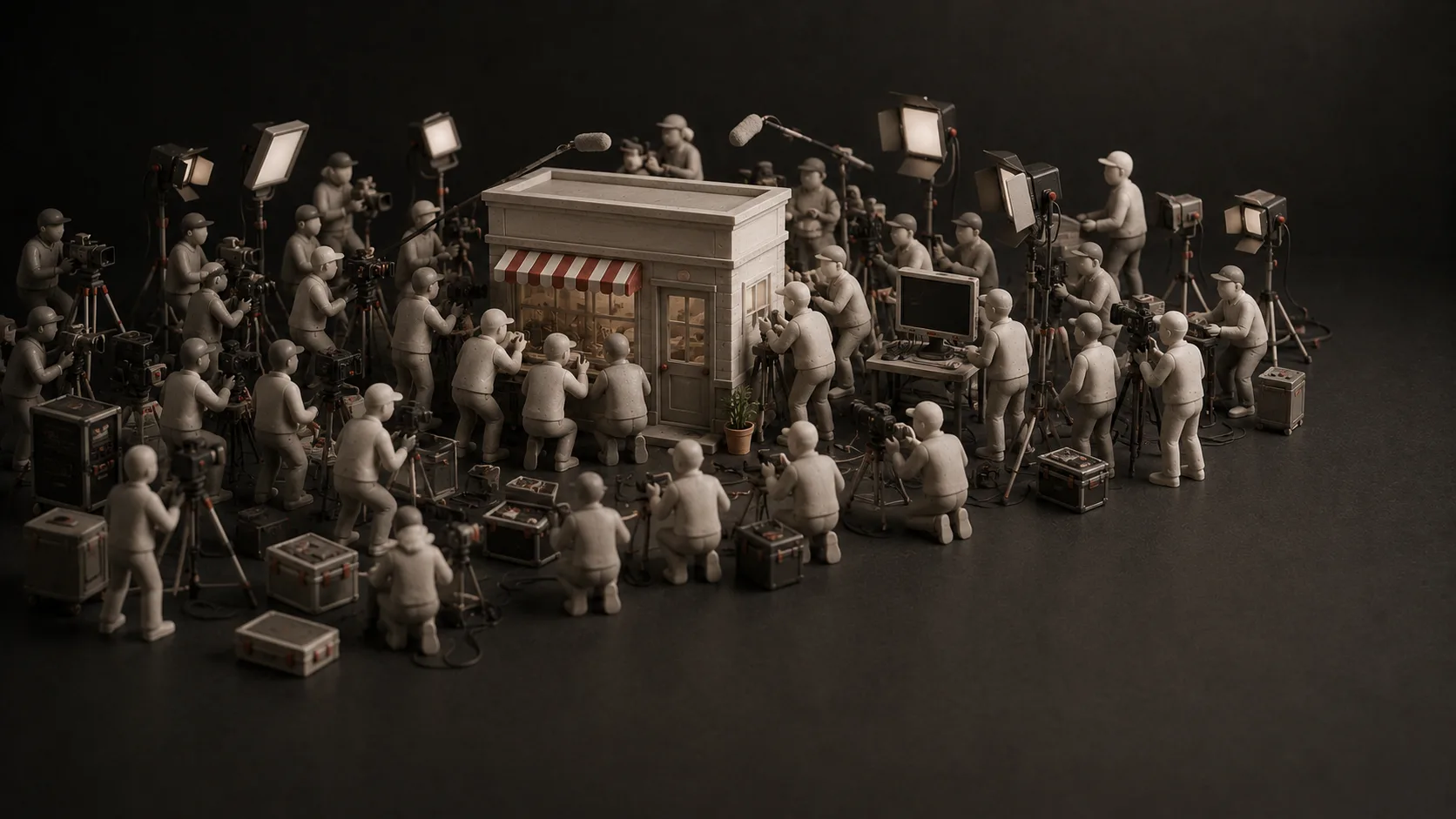
Businesses in Bend and Central Oregon have plenty of creative video talent available. That does not mean every small business needs to start with a giant production crew every time it needs useful video.
Big productions have their place. National campaigns, complex commercials, large scripted shoots, and high-control creative concepts can absolutely need a full crew.
But a lot of business video does not need to begin there. It needs a clear plan, efficient capture, strong editing, good sound, and deliverables built for the places customers actually see the business.
When a full crew makes sense.
A full production crew makes sense when the job has real production complexity: multiple locations, talent, heavy lighting, controlled audio, scripted scenes, complex product shots, permits, larger brand stakeholders, or a campaign that depends on a very specific visual world.
Some projects need producers, assistants, dedicated audio, stylists, lighting teams, and extra hands because the final piece depends on that level of control.
The point is not that big production is wrong. The point is that the size of the production should match the job.
When a full crew is probably overkill.
A full crew may be overkill when the business needs a clear homepage video, a few strong shortform pieces, a launch asset, usable process footage, a better Google Business Profile presence, YouTube support, or a practical batch of content from a normal workday.
If the shoot becomes bigger than the business, something is wrong. A good business video should not require closing the doors, stopping the workday, or building a movie set around a simple message.
A leaner setup can often move through the business more naturally. People stay more comfortable. Work keeps happening. The camera captures real proof instead of asking the business to perform for a giant crew.
Cinematic is not the same as useful.
A video can look cinematic and still fail to explain what the business does, why it matters, where the customer should go next, or what makes the experience worth remembering.
In 2026, a business video has to do more than look cinematic. It has to work on the website, in the feed, on YouTube, in a sales conversation, and in the customer’s head.
The goal is not to make the shoot feel expensive. The goal is to make the content useful.
Modern content needs to work in more than one place.
A single business video may need to support a homepage, Google Business Profile, Instagram, TikTok, YouTube, ads, emails, sales conversations, and customer trust.
That changes the planning. The shoot should capture more than one polished hero shot. It should collect usable material: wide context, people, process, detail, explanation, natural sound, vertical options, horizontal options, and supporting moments the edit can turn into multiple assets.
Modern content moves fast. The production process should not be stuck in another decade.
Businesses now use video across more channels and formats.
Traditional advertising often treated video like a major campaign moment: plan the big shoot, make the big commercial, launch it, and move on. That still has its place.
But small businesses now need more frequent visibility because customers are constantly seeing other brands, other offers, other posts, and other proof. Pew Research Center reports that 90% of U.S. adults use the internet daily, and 41% say they are online almost constantly. Pew also reports very high smartphone ownership across adult age groups. DataReportal’s 2026 U.S. report lists hundreds of millions of internet users, social media user identities, and cellular mobile connections in the United States. StatCounter shows mobile devices account for about half of global web traffic, and eMarketer continues to point to mobile, digital video, and social platforms as major places where attention is spent.
The feed is not empty. Your business is not competing against silence. It is competing against every other piece of content your customer sees that day.
That does not mean posting junk. Volume without quality is noise. Quality without enough visibility is invisible. The goal is a practical balance of quality and volume.
Your favorite brands probably do not show up once a year and disappear. They post often because attention is fragmented. They test ideas. They answer questions. They show the product. They show the process. They remind people they exist.
Useful content usually needs repetition. It needs different angles. It needs a few versions. It needs short edits, longer edits, vertical cuts, website assets, launch pieces, and clips that answer real questions.
That is where lean production makes sense. A giant crew and overbuilt process can burn the budget too fast. Smaller, smarter shoots can create multiple deliverables from the same capture window, giving the business more chances to be seen, remembered, trusted, and understood.
Benefits of a smaller production setup.
Lean production is not the same thing as careless production. It means the setup is built around the business, the message, the schedule, and the final deliverables.
For small business content strategy in Bend, Oregon, that often means mobile-first video production, social-first video production, and video content for websites and social media instead of one oversized shoot with nowhere useful to go.
A lighter setup can still use strong cameras, drone, wireless audio, thoughtful lighting, clean editing, color, pacing, sound design, captions, and platform-aware formatting.
Some productions are built around gear. This is built around the business, the use case, and the realities of modern video production in Bend, Oregon.
What to ask before hiring anyone.
Before hiring a video partner, ask what the finished content needs to do and where it needs to live. Ask how much disruption the shoot will create. Ask whether the plan creates one video or a useful content library.
Also ask whether the production team understands the business before they talk about the rig. The best content usually starts with understanding what already makes the business worth paying attention to.
- What customer question should this video answer?
- Where will the finished assets be used?
- What needs to be captured while the business is actually operating?
- How much crew can the location realistically handle?
- What shortform, website, YouTube, or sales assets should the shoot also support?
Final take.
The right production is the one that fits the job.
Big production has its place. But most small businesses do not need an oversized setup every time they need strong content. They need a clear plan, a small enough footprint to keep work moving, and finished assets that help people understand, trust, and remember the business.
You do not need to make the shoot bigger than the message. You need content people can actually use.
How this applies to businesses in Bend and elsewhere.
For a small business, the strongest footage is often already happening during normal work: service, preparation, tools, trucks, products, people, and the surrounding environment. The goal is to capture it without taking over the day.
Based in Bend, Oregon, with select Pacific Northwest projects, the planning starts with how the business actually operates, then builds the shoot around practical video, shortform, and YouTube needs. Editing includes audio-minded post; FAA Part 107 drone support is available when aerial context helps.
Related questionsAnswers if you want more context
Why does mobile-first content matter for small businesses?
Because many customers now discover, compare, and judge businesses on phones before they ever call, visit, or buy. Mobile-first does not mean low-quality. It means the content is planned for the real places people see it: social feeds, YouTube, search, websites, Google Business Profiles, emails, and quick buying moments.
Is one polished brand video enough?
Sometimes it is a good starting point, but most businesses need more than one polished video. A stronger approach is often to create a useful set of assets: a main video, short vertical edits, website clips, social cuts, FAQ-style content, launch pieces, or footage that can support future posts. The goal is to balance quality and volume instead of spending the entire budget on one piece.
Does mobile-first mean the content should look cheap?
No. Mobile-first means the content is designed for how people actually watch. It still needs strong visuals, clean audio, good pacing, clear messaging, and polished editing. The difference is that the production is shaped around attention, usefulness, and distribution instead of just making something look cinematic on a large screen.
Do small businesses need a full production crew?
Not always. Some projects need a larger crew, but many small-business videos need a focused plan, clean capture, good sound, practical gear, and defined deliverables more than a large production footprint.
Does a lean setup mean lower quality?
No. Lean does not mean amateur. It means the shoot is built around what the content actually needs. Strong capture, smart editing, sound, pacing, and finished deliverables matter more than unnecessary production complexity.
Sources7 references used for context
This guide combines source-backed context with Maverick Beach Creative’s working approach to planning and producing small-business content.
- Internet, Broadband Fact Sheet — Pew Research CenterProvides context on how often U.S. adults use the internet, including daily and almost-constant use.
- Mobile Fact Sheet — Pew Research CenterProvides context on smartphone ownership across U.S. adult age groups.
- Desktop vs Mobile vs Tablet Market Share — StatCounter Global StatsProvides context on the share of web traffic coming from mobile, desktop, and tablet devices.
- Digital 2026: The United States of America — DataReportalProvides context on U.S. internet users, social media user identities, and cellular mobile connections.
- US Time Spent with Media Forecast 2026 — eMarketerProvides context on mobile media habits, digital video growth, social network time, and TikTok usage expectations.
- 2026 State of Video Report — WistiaProvides context on modern video workflows, distribution, and repurposing.
- Video Content Creation Strategy, Tips & Tools — YouTube CreatorsSupports planning video around the audience, topic, format, and purpose.
Related Next Steps