AI + Content
What AI Is Good At, and What It Still Cannot Replace
AI is great at speeding up the middle of the process. It is not great at replacing the real footage, taste, context, and final judgment that make content actually work.
By Maverick Beach / June 10, 2026
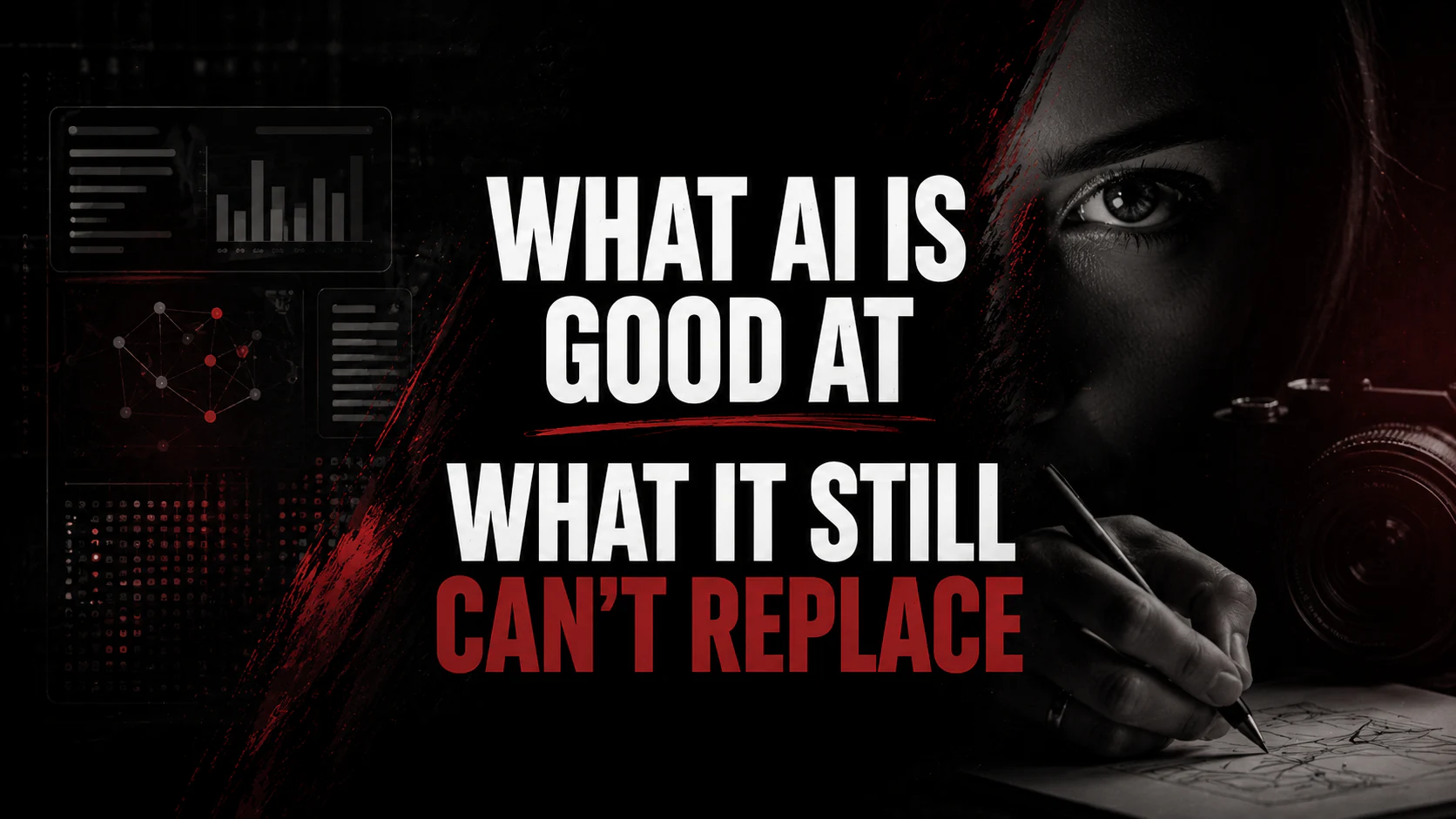
Treat AI like a power tool.
A power tool is valuable because it does a specific job faster. Nobody hands it the blueprints, walks away, and expects the building to make sense.
That is the useful way to think about AI in 2026.
Some tasks belong in its hands. Some tasks need supervision. Some tasks should never be delegated.
The advantage is not using AI everywhere. The advantage is knowing where to put it.
The boundary is moving
This field guide has a timestamp. The boundary between what AI handles well and what it handles poorly will keep moving.
That does not make the map useless. It means the map needs regular updates.
The practical move is to separate work into three zones: tasks AI can own, tasks AI can assist, and decisions a person should keep.
New tools may move a task from one zone to another. Accountability does not move with it.
Green zone: let AI carry the repetition
The green zone is repetitive, reversible work.
Let AI summarize the transcript, group customer questions, clean rough notes, create file-name ideas, compare versions, or turn a finished longform video into a list of possible smaller topics.
If the output is mediocre, nothing expensive or public has happened yet. Review it, correct it, and keep moving.
This is where AI earns its keep: it removes minutes and hours from work that still needs to happen but does not deserve all of your attention.
Yellow zone: use AI, then inspect the work
The yellow zone includes work that affects the customer but can still be reviewed before it leaves the building.
Caption drafts, talking points, shot-list ideas, content calendars, product explanations, and rough creative directions all fit here.
AI can produce the first pass. Someone who understands the business must inspect the facts, tone, promise, and usefulness.
Think of it like a junior assistant with unlimited energy and no fear of being confidently wrong.
AI is good at organizing messy information
A small business usually has more useful material than it realizes: customer questions, product details, old captions, service explanations, menu updates, launch ideas, phone footage, common objections, reviews, behind-the-scenes moments, and half-finished post ideas.
The problem is that it is usually scattered everywhere.
AI can group ideas by topic, turn customer questions into video ideas, pull possible shortform clips from a transcript, identify what customers might misunderstand, and suggest content that explains each service.
That is a great use of AI. Not because it understands the business better than the owner, but because it helps organize the pile.
Once the pile is organized, a human can make better decisions.
AI is good at options
AI is also very good at options. That is one of the best ways to use it.
Do not ask AI for the answer. Ask it for five directions, ten hooks, three caption styles, or a list of possible talking points. Ask it for rough ideas, then judge them yourself.
You are not handing it the wheel. You are using it to create options faster.
A restaurant can explore angles around ingredients, prep, service, customer reactions, local sourcing, or the story behind a menu item. A shop can organize a product explainer by questions, problem and solution, features, use cases, and mistakes. An outdoor brand can explore field-use angles, objections, benefits, and follow-up posts.
The business still decides what feels right.
AI is good at repetitive work
This is where AI can genuinely make a business more efficient.
A lot of content work is repetitive. Not pointless, but repetitive.
Writing caption options, pulling possible shortform topics, summarizing transcripts, cleaning notes, drafting calendars, sorting ideas by platform, making checklists, outlining posts, writing rough YouTube descriptions, and building first-pass shot lists all take time.
AI can speed that up.
That means the human can spend less energy on the first-pass version and more energy making the final version better.
AI should not make you care less. It should give you more time to care about the parts that matter.
AI is good at helping people who already know what they want
The better you understand your business, the more useful AI becomes.
If you have no idea what your business sounds like, who the customer is, what the offer is, what you are trying to say, or what good content looks like, AI will probably give you generic output.
But if you know your business and give AI strong direction, it can become extremely useful.
AI works better with context. That is why prompting is not just typing. Prompting is direction.
- what the business does
- who the customer is
- what the goal is
- what the content is for
- what footage exists
- what tone fits the brand
- what words to avoid
- what the viewer should understand
- what the final output needs to do
AI is good at helping small businesses move faster
AI can help a small business do things that used to take more time, people, or money.
It can help with planning, writing, organizing, repurposing, brainstorming, summarizing, outlining, and turning raw ideas into usable starting points.
That does not replace the product, service, team, customer experience, footage, or brand. But it can help the business move faster around those things.
A small business does not need to become an AI company. It just needs to stop starting from zero every time it needs content.
Red zone: keep a person accountable
The red zone is work where the wrong decision can damage trust, waste a shoot, misrepresent a product, or make the business promise something it cannot deliver.
Final creative direction, factual claims, customer promises, brand positioning, what gets filmed, what gets cut, and what gets published need a person attached to the decision.
That is how you get AI slop: fake-sounding captions, weird event graphics, posts that sound like nobody involved has ever been inside the business, and “elevate your brand” garbage.
The problem is not always the tool. The problem is asking the tool to do too much with too little context.
AI is much better when it has a specific job: organize these ideas, draft five caption options, summarize this transcript, suggest customer questions, build a rough shot list, or group these clips by topic.
“Do our marketing” does not work.
AI is bad at knowing what matters
AI can produce an answer. That does not mean it knows what matters.
It can sound confident while missing the point. It can give a polished answer that is not useful, create a clean caption that does not sound like the business, or suggest a content idea that makes sense on paper but would be awkward in real life.
That is why human judgment matters.
A person has to know what should stay, what should go, when the output is wrong, when content sounds fake, and when something is technically fine but not worth posting.
AI can help create options. It cannot care which option is right.
AI is bad at real-world context
AI does not know what happened in the room.
It does not know the energy of the business, which employee is actually good on camera, what the customer asked before the camera rolled, which moment felt real, which industry detail matters, or the difference between a nice shot and a shot that explains something.
That context comes from being there. It comes from shooting, editing, listening, watching, and understanding the business.
AI can help with planning and organization around the content. It cannot replace the real-world part of content creation.
AI is bad at taste
Taste is hard to explain, but everyone can feel when it is missing.
A video can be sharp, clean, and technically fine but still feel wrong. A caption can be grammatically correct but sound fake. A graphic can have the right information and still look cheap. A cinematic shot can add nothing.
Taste is knowing when less is better, when the music is too much, when the cut is too slow, when the opening does not hit, when a line sounds forced, when a graphic feels cheesy, or when the whole piece is trying too hard.
AI can imitate style. It cannot be trusted to have taste.
The human still has to make that call.
AI is bad at emotion
AI can imitate emotion. It can write something sad, exciting, inspirational, dramatic, or sentimental. But it does not feel any of it.
Emotion in content is not just word choice. It is context, timing, restraint, knowing what a moment meant, and knowing when to let something breathe.
AI can help draft emotional language. A human has to know whether the emotion is real or just being performed.
AI is bad at replacing real footage
AI can generate images and video. It is getting better and will keep getting better. But for most small businesses, real footage is still the foundation.
A restaurant needs to show the actual food. A shop needs to show the actual process. A product needs to be used in real conditions. A team needs to sound like real people. A space needs to feel like itself.
AI-generated content can support a project through graphics, concepts, mockups, or small pieces. But it should not replace the reality of the business.
People can feel when something is fake, even when they cannot explain it.
AI is bad at end-to-end creative work
AI can help with pieces. It can draft, outline, summarize, generate ideas, support graphics, organize information, and help build a plan.
But the whole creative process needs direction, shooting, editing, pacing, sound design, visual judgment, brand understanding, platform understanding, and a final decision about what the audience should feel or do.
That is not one prompt. That is a process.
If you hand the entire process to AI, you usually get something that looks like it came from AI. Maybe clean. Maybe fast. Maybe good enough for someone not paying attention. But not content that makes a real business feel like a real brand.
Give every AI task an owner
Every AI-assisted task should still have a person responsible for the result.
Who checks the facts? Who approves the wording? Who decides whether the footage supports the claim? Who knows when the idea does not fit the room, customer, or business?
If nobody owns the answer, the tool is not saving time. It is moving risk downstream.
The best use of AI is support
The best use of AI is not replacement. It is support.
Use AI to help plan the shoot, organize ideas, build rough talking points, turn customer questions into content ideas, summarize transcripts, pull hooks, draft captions, create a simple content calendar, compare options, and make the annoying middle work faster.
Then bring human taste back in.
That is where AI becomes valuable.
How Maverick Beach Creative can help
This work starts by drawing the boundary around a real content process.
Maverick Beach Creative can identify the repetitive tasks worth accelerating, the review points that protect the business, and the production and editing decisions that still need direct human ownership.
The result is not an AI system for its own sake. It is a clearer division of labor.
- planning a shoot with clearer goals
- organizing footage and content ideas
- turning one shoot into multiple useful pieces
- building talking points instead of stiff scripts
- drafting captions and hooks
- creating a practical content calendar
- editing raw footage into finished videos
- using sound design to make the edit feel polished
- keeping AI behind the scenes where it belongs
Final take
Use AI aggressively in the green zone. Supervise it in the yellow zone. Keep a person accountable in the red zone.
That map will change as the tools improve.
The responsibility for the finished work will not.
What this means for Bend small businesses
For local businesses using AI, the useful move is usually small and practical: reduce repetitive work while keeping the real voice, footage, customer context, and final decisions connected to the business.
Maverick Beach Creative helps Bend and Central Oregon businesses use AI as practical workflow support while keeping the voice, footage, judgment, and finished creative connected to real people.
Related questions
Do you use AI?
Yes, but not as a replacement for the creative work. AI can help organize ideas, structure plans, draft caption options, summarize notes, and make workflows faster. The final work still depends on real footage, editing, sound, pacing, taste, and human judgment.
What does “AI-supported, not AI-replaced” mean?
It means AI can help with the messy parts around the work: notes, ideas, outlines, captions, planning, and organization. The actual value still comes from real business context, real footage, strong editing, sound, pacing, and taste.
What is AI good at for small-business content?
AI is useful for sorting ideas, outlining, summarizing, drafting options, repurposing, and reducing repetitive work. It is strongest when given real context and a narrow job.
What should AI not replace?
AI should not replace real footage, customer context, brand voice, taste, accountability, or the final creative decision.
Can AI help with content without making it sound fake?
Yes, when AI supports organization, drafts, and repetitive work while real business details, voice, footage, judgment, and final decisions stay human.
Sources
Outside sources support the argument without replacing the point of view.
- What is Generative AI? — IBM Supports the definition of generative AI as a tool that can create text, images, video, audio, and code from prompts.
- What are AI Hallucinations? — IBM Supports the point that AI can produce inaccurate or nonsensical outputs and still sound confident.
- Prompt Engineering for AI Guide — Google Cloud Supports the importance of prompt design, context, and instructions when using AI tools.
- Best practices for prompt engineering — Google Cloud Blog Supports the value of specificity, contextual prompts, and examples for better AI outputs.
- Generative AI at Work — National Bureau of Economic Research Supports the idea that generative AI can improve productivity when used as assistance in a real work setting.
- Copyright and Artificial Intelligence — U.S. Copyright Office Supports the broader point that human authorship and human creative contribution still matter in AI-assisted work.
Related resources
Need to separate useful AI support from the hype?
Start with one workflow problem and keep the real footage, context, and final judgment in human hands.